Showing posts with label Canadian Gulfstreams. Show all posts

Thursday, 14 March 2019

Canadian Gulfstreams - Part 6

During the past 60 years, three key specifications have driven the evolution of corporate jet design. They are: range, speed and cabin size. A new standard was set with the first flight of the Gulfstream G650 on November 25, 2009. It can fly 7,000NM at Mach .85 - a 17% improvement on the G550's maximum range of 6,000NM at M.85. Perhaps more importantly, the G650 can travel 6,000NM at M.90. Gulfstream has since introduced an enhanced fuel capacity modification that is available for G650s either in service or on order. The G650ER can fly 7,500NM at M.85 or 6,400NM at M.90.

Not to be left behind, Bombardier has responded with its new Global 7500. While it and the G650ER share the same published long-range cruise speed of M.85, high-speed cruise speed of M.90 and top speed of M.925, the Global 7500 has an advertised maximum range of 7,700NM versus the G650ER's 7,500NM. The most significant difference between the two aircraft appears to be cabin size. Assuming the installation of a dedicated crew rest station aft of the cockpit, the G650ER has a three zone cabin, while the Global 7500's longer fuselage accommodates a four zone cabin.

Given that more than 400 G650s/G650ERs have been ordered to date, it will be interesting to see how large the market ultimately is for corporate jets that cost more than US$65 million.

Of the more than 340 Gulfstream G650s/G650ERs currently operating, so far only two wear Canadian registrations. The first example, a G650 (6162, C-GNDN), was delivered new to a family in Calgary in December 2015. Having previously had a G450 and a G550, this upgrade might have been expected. The second unit is a G650ER (6252, C-FYRC). It had previously served as a Gulfstream Aerospace demonstrator before being purchased by a Calgary investor in November 2017.
Photo of 6252 at Montreal by Bill Fawcett.
Photo of 6162 at Farnborough by Bob Holland.

Thursday, 7 March 2019

Canadian Gulfstreams - Part 5

Until 1995, corporations and governments that required an aircraft capable of flying more than 5,000NM non-stop had to use modified airliners. The first purpose built business aircraft with such an extensive range was the Gulfstream V. It first flew on November 28, 1995 and could fly 6,500NM while cruising en route at Mach .80. That was a 54% improvement over the Gulfstream IV/IV-SPs' range of 4,220NM at M.80. Bombardier's entry into the ultra long range competition, the Global Express, first flew on October 13, 1996. It also offered a range of 6,500NM at M.80. Dassault later became the third player in the exclusive market niche with the first flight of its Falcon 7X on May 5, 2005. It could fly 5,950NM at M.80.

Since then, all three airframers have introduced variants of these models. They tend to feature slightly improved range and speed capabilities. Gulfstream's G550 flies 6,750NM at M.80. Bombardier's Global 6000 (originally named Global Express XRS) flies 6500NM at M.82, while the slightly shorter Global 5000 flies 5,200NM at M.85. Finally, Dassault's Falcon 8X flies 6,450NM at M.80.

The first Canadian fifth generation Gulfstream was a new G550 (c/n 5230, C-GNDN) that was delivered to a family in Calgary in June 2009. It became C-GXDN in January 2015, then was exported in January 2016. The second one to join the CCAR was a Gulfstream V (c/n 692, C-GLFV) that arrived at its Toronto base in November 2009. The appropriately registered airplane still wore its original Toyota Motor livery.

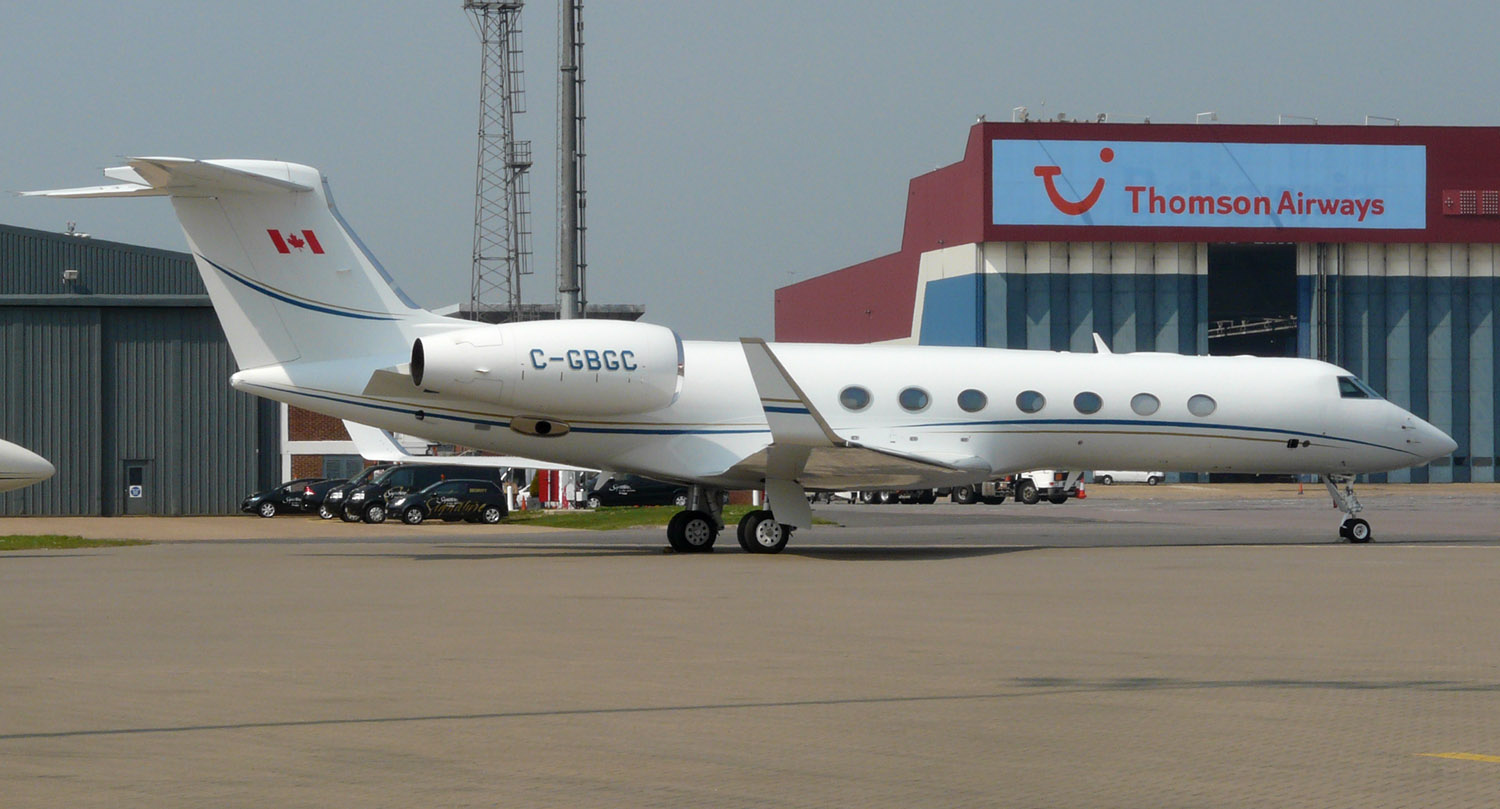
In March 2011, another new G550 (c/n 5306, C-GBGC) was delivered to a major gold miner in Toronto. Later reregistered as   C-GGPM, it remains with the same operator today. Subsequently, three previously owned units have joined the Canadian corporate fleet. They are c/n 641, C-GUGU in Vancouver; c/n 5283, C-GMCR in Calgary; and c/n 5491, C-GLFG also in Calgary.

As has been the case with the fourth generation Gulfstreams, the fifth generation models have had a difficult time penetrating the Canadian market. The favourite type within this exclusive niche is the Bombardier Global family that is produced in Toronto. Today, the Canadian Civil Aircraft Register shows that Canadian corporations (excluding Bombardier) operate 29 Globals, eight Falcon 7Xs, two Gulfstream Vs and three Gulfstream G550s.
C-GLFV, the penultimate Gulfstream V. Photo by Frederick K. Larkin

G550s C-GBGC and C-GNDN by Bob Holland

Thursday, 28 February 2019

Canadian Gulfstreams - Part 4

During the early 1980s, corporate jet buyers expressed their interest in an aircraft that could fly farther and faster, be more fuel efficient and produce less noise in the process. More stringent noise regulations were threatening operational flexibility, especially at sound sensitive airports. Dassault responded on Sept.21, 1984, when its Falcon 900 wide-body tri-jet first flew. It could fly 4,300NM at Mach .75. This presented a challenge to the Gulfstream III's range of 3,650NM at M.77. A year later, on Sept. 19, 1985, the first Gulfstream IV flew. Its range was 4,220NM at M.80. Besides being capable of flying 15% farther than the GIII, it had a 4.5' longer cabin and quieter Rolls-Royce Tay engines. A year after that, on Sept. 28, 1986, the first Canadair Challenger 601-3A flew. Its range was 3,100NM at M.80. After their respective certifications, all three were operating with flight departments in the fall of 1987.

The first Canadian GIV (c/n 1032, C-FSBR) was delivered to Denison Mines in Toronto in November 1987. The loyal Gulfstream customer had previously operated a GI, a GII and a GIII. It would be almost six years before another new GIV was delivered to a Canadian customer. The Seagram Company of Montreal took delivery of c/n 1207 (C-FDCS, later C-FJES and N77SW) in August 1993. Its U.S. subsidiary (Joseph E. Seagram & Sons) had been, and would continue to be, a significant Gulfstream operator. Over time, it operated two GIIs, two GIIIs, seven GIVs and two GVs.

When previously owned GIVs became available at more attractive prices, Canadian operators took more interest in the type. Since 1993, two GIVs (c/n 1065, C-FCNR and c/n 1103, C-FHPM) and five GIV-SPs (c/n 1224, C-GEIV; c/n 1238, C-GCPM; c/n 1336, C-FORB; c/n 1382, C-GMRX; and c/n 1466, C-FLMS) have been operated by Canadian companies. In addition, three previously owned GIV-Xs (G450s) have been purchased by Canadians. These have included c/n 4030, C-GXDN; c/n 4047, C-GFCP; and c/n 4308, C-FDBJ.

As had been the case with the GIII, the Canadian market proved to be a difficult one for Gulfstream to penetrate with the GIV. Likewise, Dassault delivered only three new Falcon 900s to Canadians from 1987 until 2000. The Canadair/Bombardier Challenger 600/601/601-3A/601-3R/604/605/650 family has dominated the high end corporate jet market in Canada. Of the 901 fourth generation Gulfstreams built, only 12 have worn a Canadian registration. Only a pair were purchased new.
Photos by Frederick K. Larkin

Thursday, 21 February 2019

Canadian Gulfstreams - Part 3

By 1975, Gulfstream II owners were expressing an interest in an aircraft that could fly farther and faster. In April 1978, Grumman American introduced the G-1159A Gulfstream III. It had a two-foot longer cabin, new wings with winglets and a more streamlined nose and cockpit section. Despite having the same Rolls-Royce Spey engines as the GII, the GIII had a 27% greater range (3,650NM vs 2,860NM) and a slightly higher cruise speed (M.77 vs M.75).

On August 31, 1978, Grumman Aerospace sold Grumman American to American Jet Industries. AJI changed its name to Gulfstream American and expressed its confidence in the new Gulfstream III. When the prototype was unveiled at Savannah on September 21, 1979, there were 52 orders in hand. The first GIII took flight on December 2, 1979. By the end of that month, the final (256th) GII departed the factory. The GIII received its FAA certification on September 22, 1980 and the first customer delivery (c/n 301, N100P) was made on April 15, 1981.

While the GII had dominated the upper end of the bizjet market for 13 years, a new entrant was aiming to take a share of that prestigious niche. The Canadair CL-600-1A11 Challenger 600 had a wider cabin and engines that were both quieter and less thirsty than the Speys. Gulfstream II owners (including American Financial, Bristol-Myers, Chrysler, Citibank, W.R. Grace, Northrop, Texaco, Time and Xerox) purchased Canadian-built Challengers.

The new competitor had an even greater impact in its home market. The first two Canadian GIII customers had both operated GIIs. Denison Mines of Toronto received c/n 307 (C-GSBR) in August 1981 and Kaiser Resources of Vancouver took delivery of c/n 317 (C-GKRL) a month later. These would be the only two new GIIIs purchased by Canadian companies.

During 1987, there was only one Canadian GIII operating. At the same time, there were seven Canadian corporate Challenger 600/601s in service.

Kaiser's airplane had a short stay, as it was exported to the U.S. in July 1982. Denison's GIII was later operated by Olympia & York Developments as C-GSBR from July 1989 until July 1992. It then became C-GGPM with Peter Munk's American Barrick Resources and remained in Canada until May 2002. Only two other GIIIs wore a Canadian registration. Execaire of Montreal operated c/n 310 as C-FYAG for just over seven months during 1990 and c/n 368 was later operated out of Toronto by Chartright Air as C-GBBB from 1999 until 2012. Of the 202 Gulfstream IIIs built, only four were owned by Canadians.
C-GSBR at Castle Donington in 1987 by Steve Blood
C-GBBB at Luton in 2006 by Bob Holland

Thursday, 14 February 2019

Canadian Gulfstreams - Part 2

The bizjet era dawned with the first flight of the Lockheed L-1329 JetStar on September 4, 1957. Within the next seven years, another seven new types (including the North American NA-265-40 Sabreliner, de Havilland DH-125, Rockwell 1121 Jet Commander, Dassault Falcon 20, Lear Jet 23, HFB-320 Hansa Jet and the Piaggio-Douglas PD-808) had flown. While they all flew faster and higher, none of them had the range or cabin size of the Grumman G-159 Gulfstream turboprop.

At that time, Grumman had been asking G-159 owners if they would be interested in a jet version of the aircraft. After it was determined that a market did exist for a corporate jet that could fly non-stop across the Atlantic Ocean, production of the G-1159 Gulfstream II was launched on May 5, 1965. It first flew on October 2, 1966 and the first customer aircraft (c/n 5, N100P) was delivered in early 1968. On May 5 that year, N100P became the first corporate jet to cross the pond non-stop when it flew from Teterboro, NJ to London's Gatwick Airport.

The first Canadian GII (c/n 7, CF-HOG) was received by Home Oil at Calgary in August 1968. The second (c/n 9, CF-SBR) went to Denison Mines at Toronto a month later. Each of those companies had operated a G-159 before replacing it with a Dassault Falcon 20C. Now they had upgraded to Grumman's flagship.

During the following 11 years, three more new GIIs arrived in Canada: c/n 52, CF-FNM with Falconbridge Nickel Mines in Toronto; c/n 140, C-GTWO with International Nickel in Toronto; and c/n 232, C-GDPB with Dome Petroleum in Calgary. As well, ten previously-owned GIIs flew for Canadian companies including Imperial Oil, Noranda Mines, Kaiser Resources, TransCanada PipeLines, Ranger Oil and Bell Canada. One of these other examples (c/n 28, C-GCFB) was operated by Transport Canada as an airways calibration aircraft.

During the past half-century, 15 of the 256 Gulfstream IIs built have graced the Canadian Civil Aircraft Register. Today there are none.
The first three Canadian GIIs at Toronto. Photos courtesy of George Trussell.


Thursday, 7 February 2019

Canadian Gulfstreams - Part 1

Subsequent to WWII, the largest aircraft operated by Canadian companies were the Douglas DC-3, the Lockheed 18 Lodestar and the Grumman G-73 Mallard. These large cabin aircraft were loud and flew low and slow. With the arrival of turbine power, corporations desired faster and more comfortable airplanes. When Grumman introduced its G-159 Gulfstream in June 1957, Canadian flight departments took note of the pressurized turboprop. Gulfstream c/n 7 first flew on July 23, 1959 and was delivered in mid-January 1960 as CF-LOO to Home Oil in Calgary, Alberta. During the following three years, new G-159s were delivered to George W. Crothers (31 / CF-JFC), Massey-Ferguson (54 / CF-MUR), Imperial Oil (60 / CF-IOM), Westcoast Transmission (72 / CF-NOC) and Algoma Steel (115 / CF-ASC). Brand loyalty played a role, as Crothers, Imperial Oil  and Algoma Steel had previously owned Mallards.

As time passed, the type became more affordable in the secondary market and numerous corporations and commercial operators added G-159s to their fleets. Besides its initial role as an executive transport, the Gulfstream provided logistical support for natural resource development in remote regions of the nation, was used as a regional airliner with a 24-seat interior, acted as a platform for geophysical surveys, and performed nocturnal missions as freighters.

Between 1958 and 1969, 200 G-159s were built by Grumman at Bethpage, New York. Of those, 25 wore a Canadian registration. Today fewer than a dozen airframes remain airworthy around the world. The sole example on the CCAR is C-FAWE (188). Currently withdrawn from service at Rouyn-Noranda, Quebec, it would be wonderful to hear its R-R Darts spool up and to see it airborne once again.
CF-MUR (054) taken in 1964 at Toronto. With permission from George Trussell
C-FCOL (064) and C-FAWG (106) courtesy of Caz Caswell