Showing posts with label "Gulfstream in uniform". Show all posts

Sunday, 3 March 2019

Gulfstream in Uniform : Part VI

Gulfstream V/550 : Electronic warfare

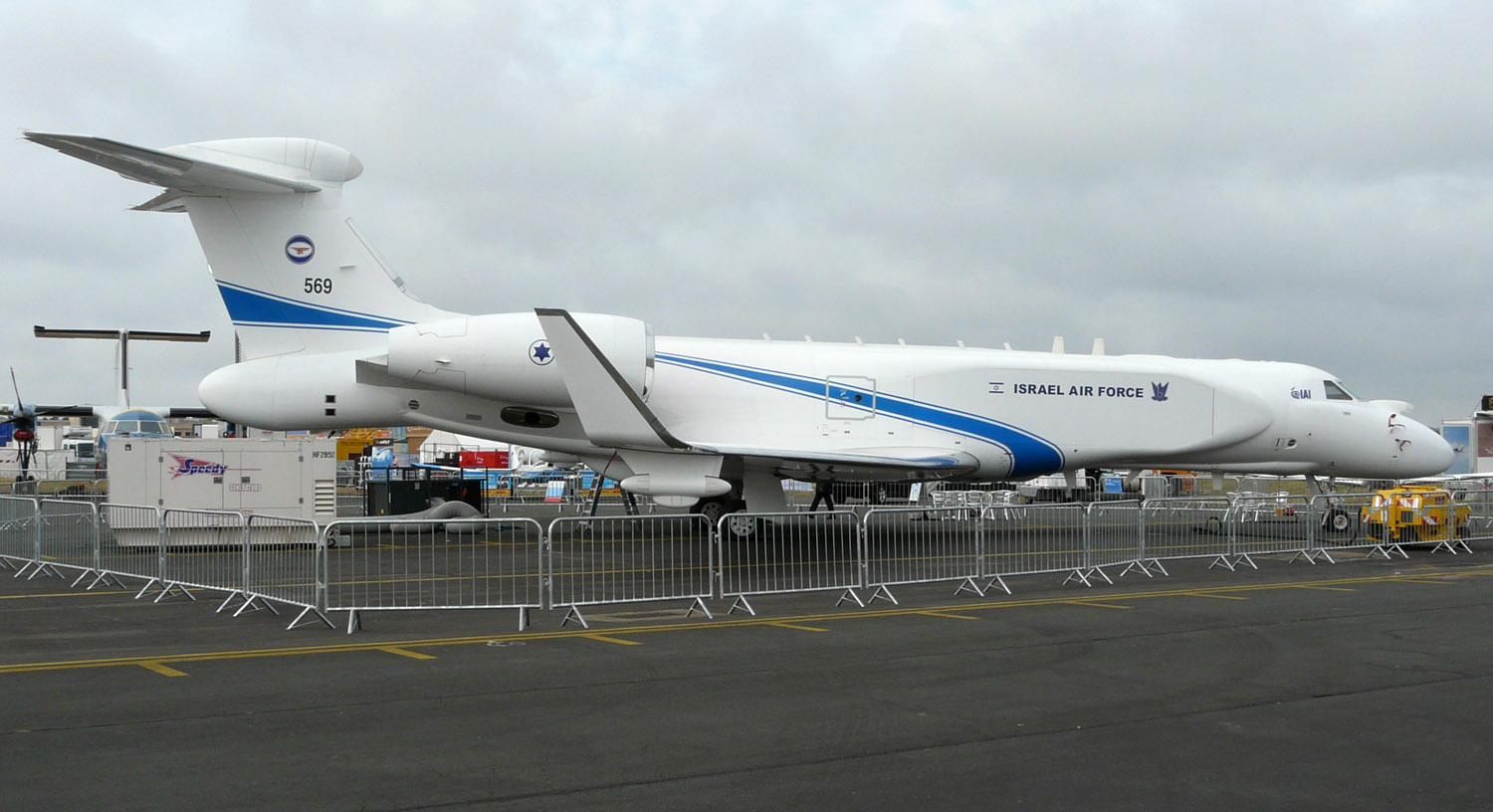
Gulfstream and IAI rolled out the first Gulfstream V "Shavit" in early 2005, this was followed with an official hand over to the Israeli Air & Space Force (IASF) in June the same year. The conversion from a green Gulfstream V to a signal/intelligence (SIGINT) aircraft was taken up at IAI's Tel Aviv Ben Gurion airport facility. Only three Gulfstream Vs undertook the conversion, all future projects were to be on the Gulfstream G550 airframe.

In September 2006 Gulfstream delivered the first of two G550s to Tel Aviv, this was to be the first  Conformal Airborne Early Warning (CAEW) aircraft that the IASF would be adding to the Shavit fleet. The new CAEW aircraft were locally designated the Eitam. All five aircraft are flown by the Nachshon squadron at Nevatim Airbase, Israeli have announced at least one more Eitam will join the fleet.

Singapore was to be the next Air arm to take delivery of a IAI's Gulfstream G550 based CAEW airframe. Four frames undertook conversion and fly with 111sq based at Tengah Air Base, deliveries started in 2008 and by 2010 they were fully operational. IAI provided Italy with two airframes, the deal which saw 30 M346 trainers going in the opposite direction to Israel was completed in 2016.

The Australian Government awarded L3 Technologies a contract for two Gulfstream 550s to be converted to electronic warfare support configuration, these are expected to be the first of five MC-55As that the Royal Australian Air Force (RAAF) will operate from RAAF Edinburgh.

The US Navy have recently announced that VX-30 at NAS Point Mugu, California will be operating a NC-37B for missile range support. Although N544GD is painted in full "Bloodhounds" markings it is expected to be some time in 2021 before it is flying in its full operational capability as 166379.

Not wanting to miss out on the Department of Defence (DOD) gravy train, BAE Systems has partnered with L3 Technologies to integrate the Compass Call system from a Lockheed EC-130H into the Gulfstream EC-37B. the Electronic Warfare system could see as many at 14 EC-37Bs required to replace the ageing Hercules based at Davis Monthan, Arizona.

As the Gulfstream G550 nears its conclusion, we could certainly see some of the final frames being used for a number of roles that will see them wearing military uniform.
Photo by Ian Harding
Photo by Bob Holland

Monday, 18 February 2019

Gulfstream in Uniform : Part V

Gulfstream V/G550 : VIP jets

With the introduction of the Gulfstream V, existing Gulfstream operators now had an opportunity to fly further and faster than ever before, this allowed air forces to have a jet that could not only carry VIPs with less stops in the finest of comfort but it also made way for a totally new platform to be created in the form of aerial surveillance, I will look into this in the next part of the Gulfstream V/G550 story.

The Gulfstream V took on the designation of C-37A, Gulfstream delivered the first frame to the US Air Force in 1997, another 9 airframes followed and were split across the USAF. These were used with continental, Pacific and European fleets. Both the US Army and US Navy also operated a small number of the C-37A.
As would be expected, the US Coast Guard also upgraded and took on a new build Gulfstream C-37A and took delivery in 2002, this was later complimented in 2017 with a secondhand G550 and designated C-37B.
The slight abbreviation of C-37B, was to be the designation for the Gulfstream G550 and all three services took on the type, the US Navy added three C-37Bs. While the US Army and US Air Force also still fly a small fleet of the C-37B.

Outside of the United States, Greece operate a Gulfstream V for VIP duties, while Turkey, Poland, Mexico and Sweden all have G550s in their Air Force inventories.

Not worthy of its own post just yet. Only one Gulfstream G650 so far has entered military service, Zambia took delivery of AF001 late in 2018. Although not having reached Zambia just yet, as it is currently in Basel, Switzerland having some aftermarket extras fitted, I doubt this will be the only military G650 though.

Both images by Westleigh Bushell

Sunday, 10 February 2019

Gulfstream in Uniform : Part IV

Gulfstream IV family

The US military continued their relationship with Gulfstream when the airframer introduced the Gulfstream IV and then the updated IVSP. Entering service in 1990, the US Air Force operated two C-20H and flew the type until 2017. Upon retirement from USAF service, one went onto the civil market while the other was transferred to the US Army (90-0300) which joined the single C-20F which has been in Army service since 1991.

The US Navy operated four C-20Gs, equipped with a cargo door, they are able to operate with a mixed passenger and cargo interior. Later requirements by the Navy to replace the ageing C-20A in the CATBIRD role was made easier with the C-37A entering service, this allowed C-20G (Bu165151) to take up the CATBIRD duty and is still current today. To make it a full house, the US Marines operate a single C-20G, this airframe (c/n1200) was severely damaged by a tornado in Florida back in 1998, after a complete rebuild of the forward fuselage, wing and tail section it was able to return to USMC service in 2001.

Foreign operators of the Gulfstream IV have seen service with a handful of forces, Saudi Arabia, Ireland, Oman, Chile, Turkey, Botswana, Pakistan and the Netherlands have all flown the Gulfstream IV.  But two other nations have flown the type in a different role to the normal VIP duties.
Sweden : Three Gulfstream IVSPs, (one is a standard VIP jet) but the other two were purchased to replace a pair of French built Caravelles, the Gulfstreams are locally designated as the S102B Korpen and have multiple external lumps and bumps housing a range of intelligence equipment. Their main mission is focused around the Baltic Sea area.
Japan : Five Gulfstream IVSPs have been delivered to the JASDF with a rapid change interior, these jets are used in a multi mission role. Much like the US Navy birds, the JASDF Gulfstreams are equipped with a side cargo door. The conversion of the locally designated U-4 was carried out by Marshalls Aerospace at Cambridge Airport, England. All five U-4s are still kept very busy at their Iruma Airbase.

Gulfstream updated the ageing GIVSP with the Gulfstream G450. This type has only entered military service with Pakistan and Mexico before the production line ceased in 2017.
Photo by Richard Flagg

Sunday, 3 February 2019

Military G3s extra

To complement Westleigh's recent post on the subject, have dug out a couple of pics which might be of interest. MM62025 (479) of the Italian Air Force was caught at Orly in 1989 by Paul Tricker while K2961 (494) of the Indian Air Force was caught by Steve Speight at Delhi in 2008 on what must have been a bit of a sneaky trip.


Friday, 1 February 2019

Gulfstream In Uniform : Part III

Gulfstream III

When Gulfstream announced the Gulfstream III, the United States Air Force saw a jet that could replace the outgoing Lockheed C-140 Jetstars, with this began a long standing relationship between Gulfstream and the USAF. The designation of C-20A was given to the first four airframes that joined the service, these were handed over for Presidential executive transport support, with deliveries beginning in 1983.
Two C-20Cs followed in 1985 with one more following in 1986, these were handed over to 89th Airlift Wing at Andrews Air Force base, little was known about the mission these were to be used for, but presidential evacuation duties was certainly one priority.
The last batch to be delivered to the USAF were seven Gulfstream C-20Bs handed over from 1986 these also being handed over to the 89th MAW but were for a more conservative VIP duty within the Air Force. One of these (86-0205) replaced the VC-11A with the USCG although it wasn't to last as long with the service as the G-1159 did.

The US Navy and US Marine Corps also noticed the usefulness of the Gulfstream III in the VIP role and designated their jets C-20Ds one for each service was delivered mid 1987, the US Navy however took on one other, a former USAF C-20A which was delivered in 2004 to replace a VP-3A Orion known as "CATBIRD" for European VIP duties. Not wanting to be left out of the Gulfstream III party the US Army had two C-20Es both delivered in 1988 and served until 2014. unfortunately only a handful of C-20s are still in service today with most ending up at AMARG.

The Gulfstream III also saw many orders from foreign military forces with, Denmark, Mexico, Venezuela, Ireland, Italy, Saudi Arabia and India all using them in various roles. Of those nations the Indian Air Force have two heavily modified examples, the very obvious lumps on each side are long range cameras for looking into their neighbours back yard, although both have been seen flying from Delhi International, it is thought that two newly delivered Global Express jets are to replace them.
Photo by Westleigh Bushell 


Friday, 25 January 2019

Gulfstream in Uniform : Part II

Gulfstream II

The US Coast Guard extended their relationship with Gulfstream by purchasing a brand new Gulfstream II to fill their VIP needs. The Bethpage built airframe (c/n 23) was delivered in April 1969 and served with them until 1995. The VC-11A as it was known in USCG service was the first aircraft to carry the famous USCG 01 serial. Only one other Gulfstream II saw US Military service and that was c/n 45, and this was used by the US Army. it was initially designated a VC-II but was later re-designated a C-20J. A handful of civilian registered Gulfstream IIs still operate in the United States with heavy external modifications, these are operated by various divisions of the United States Air Force.

Although the Gulfstream II was widely used by Governments around the globe only a handful of military operators made use of the type, these being Venezuela, Mexico, Denmark and Oman. Probably the one that isn't very well known about is c/n 62. The Russian Air Force had Black 62 on strength for a number of years during the late 90's before selling it back on to the US civil market, very little can be found about it's flying career in Russia if indeed it actually had one.
Photo by : Eric Bannwarth


Friday, 18 January 2019

Gulfstream in Uniform : Part I


Gulfstream I

The US Navy were the largest user of the Gulfstream I in military service. The type entered service in early 1968 as the TC-4C Academe. The main role in a joint US Navy / US Marine Corps was to train A-6 Intruder bombardiers and navigators. These G159s had been produced with the A-6 Intuder's bulbous nose (see pic below) giving them a very unique look. Unsurprisingly, the retirement of the TC-4C coincided with that of the Intruder in 1995. Most of the nine frames ordered ended their careers at AMARG Davis Monthan, Arizona. Only one TC-4C remains on public view, this at the NAS Pensacola museum, Florida. A picture from last March can be seen here (link)

One Gulfstream I was operated by the US Army but carried a civilian registration and scheme (c/n 002 N40CE). The final US service to operate the G159 were the two US Coast Guard VC-4As which were used for VIP transport and as in the civilian world, these were replaced by a Gulfstream II.

Only one other Gulfstream I saw military service and that was with the Greek Air Force as a VIP transport. Currently preserved at Tatoi airbase, P9 (c/n 120) flew with the Greeks between 1964 - 1995.
via Wikipedia